Renter-friendly setup
Carafe and Classic models arrive as self-contained countertop appliances. There is no faucet to replace and no water line to tap.
Independent countertop RO guide
Discover countertop reverse osmosis filtration from AquaTru. Learn how it works, what it removes, and whether it's right for your home.
Independent editorial guide. AquaTru does not sponsor or endorse this site. Links are ordinary manufacturer links—not affiliate links today.
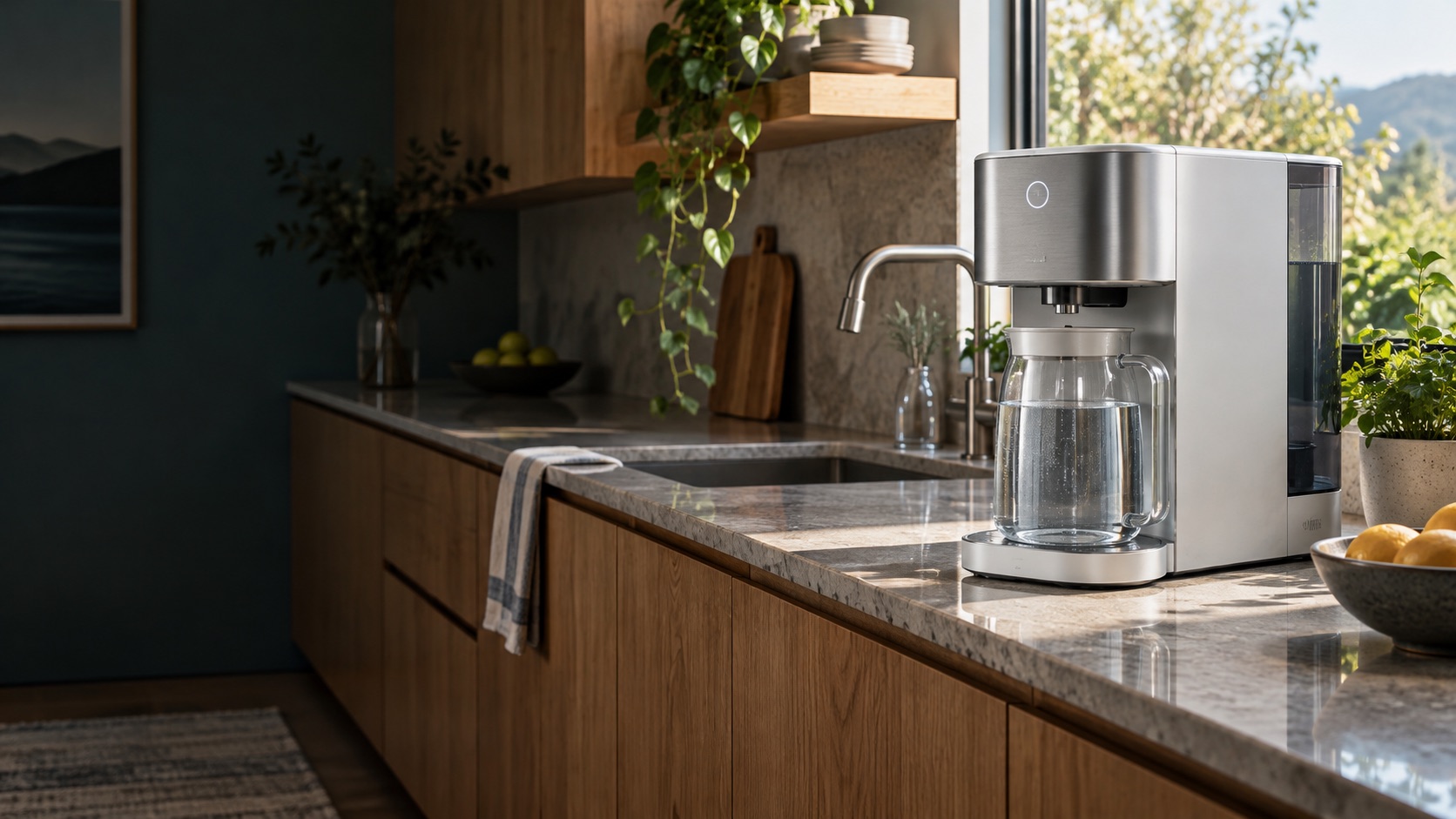
Original editorial image, not an exact product photograph.
The countertop case
Countertop AquaTru systems bring a high-reduction filtration process to kitchens where drilling, drain connections, or permanent plumbing are impractical. You fill the source tank, start a cycle, and keep the unit near an outlet.
Carafe and Classic models arrive as self-contained countertop appliances. There is no faucet to replace and no water line to tap.
AquaTru publishes model-specific performance data and says applicable systems are independently certified by IAPMO R&T.
Clean-water tanks make daily output easy to see. The tradeoff: you refill the tap-water tank and empty reject water by hand.
No permanent installation makes moving easier, but the appliance still needs meaningful counter depth, clearance, and a nearby outlet.
Four-stage treatment
AquaTru combines mechanical filtration, activated carbon, a reverse-osmosis membrane, and a final carbon polish. The stages below reflect the manufacturer's current technology description.
Captures sediment and reduces chlorine and chloramines that can affect taste and the RO membrane.
Water is pushed through a fine membrane; the system separates treated water from a concentrated reject stream.
A final carbon stage addresses listed volatile organic compounds and polishes taste before water reaches the clean tank.
Certification applies to named models and exact reduction claims—not an entire brand in the abstract. Use the performance data sheet to match the model, NSF/ANSI standard, contaminant, capacity, and operating conditions.
Read the Carafe performance data (PDF)Verified claims, properly scoped
AquaTru currently says its countertop purifiers reduce 84 contaminants. The Carafe performance sheet reviewed for this guide lists certification by IAPMO R&T according to NSF/ANSI 42, 53, 58, 372, and 401 for the claims specified in that document.
“Reduces” is not the same as “removes completely.” Results depend on feed-water quality, pressure, temperature, maintenance, and the tested capacity. This guide does not claim treatment for microbiologically unsafe water.
Two countertop starting points
Prices shown were observed on AquaTru's official site on October 15, 2026. Manufacturer pricing, packages, and availability can change.
A narrow unit with a removable 64-ounce glass carafe and about a half-gallon clean-water capacity. A practical fit for smaller households and serving at the table.
A larger countertop format with a three-quarter-gallon clean-water tank. Consider it when several people will draw water throughout the day.
Cost of ownership
The purchase price is only the first line item. Filter timing is the most predictable ongoing cost; water quality, use, and maintenance determine the rest.
Starting prices for the countertop Carafe and Classic observed on the review date. Promotions and configurations vary.
Approximate pre/carbon, finishing VOC, and RO membrane intervals published by AquaTru. Replace sooner when indicated.
Bundles and prices change. Use the official replacement-filter page, select the exact system, and estimate annual cost from today's prices.
Refill and rinse tanks, empty reject water, clean and descale as directed, and leave enough clearance to remove the tanks.
AquaTru vs. under-sink RO
| Consideration | AquaTru countertop | Traditional under-sink RO |
|---|---|---|
| Installation | Fill tank and plug in; no countertop drilling for Carafe or Classic | Plumbed to cold-water supply, drain, and usually a dedicated faucet |
| Daily use | Batch cycles; refill source tank and empty reject water | On-demand faucet with automatic tank refill |
| Space | Uses counter depth and a nearby outlet | Uses cabinet space below the sink |
| Moving | Unplug and relocate after draining and cleaning | Usually left installed or removed by someone comfortable with plumbing |
| Maintenance | Multiple filters plus manual tank cleaning | Multiple filters; may include tank sanitizing and leak checks |
| Best fit | Renters, small households, or homes avoiding plumbing changes | Higher daily demand and households that prefer continuous faucet access |
Already own a plumbed system? Use our reverse-osmosis replacement guide or under-sink filter finder.
Who should consider it?
Frequently asked questions
The countertop Carafe and Classic models do not connect to a water line. You fill the tap-water tank, plug the unit into a standard outlet, and empty the reject-water tank after a cycle. AquaTru also sells an under-sink model, which is a different installation type.
AquaTru says applicable systems are independently certified by IAPMO Research and Testing to NSF/ANSI standards for the specific reduction claims in each model’s performance data sheet. The Carafe sheet we reviewed lists NSF/ANSI 42, 53, 58, 372, and 401. Always check the sheet for the exact model and contaminant claim.
AquaTru currently states that its countertop systems reduce 84 contaminants. That number is a collection of specific, test-defined reduction claims—not a promise to remove every substance from every water supply.
AquaTru’s current guidance is approximately six months for the pre/carbon filter, one year for the finishing VOC filter, and up to two years for the reverse-osmosis membrane. Water quality and usage can shorten those intervals, and Carafe filters are not interchangeable with Classic filters.
The Carafe is the narrower, lighter option with a removable 64-ounce glass carafe and about a half-gallon clean-water capacity. The Classic has a larger three-quarter-gallon clean-water tank. Both are countertop, four-stage reverse-osmosis systems; model options and pricing can change.
Yes. Like other reverse-osmosis systems, AquaTru separates concentrated reject water from purified water. The countertop design collects that reject water in the source tank instead of sending it through a drain line, so it must be emptied manually.
AquaTru systems are designed for potable tap water. The Carafe performance data sheet says water above 10 grains per gallon hardness is not recommended unless softened. Well-water users should test their water and confirm the exact model’s feed-water requirements before buying.
AquaTru’s support documentation lists a one-year limited warranty for the original purchaser. Replaceable filters are excluded, and shipping or processing charges may apply. Read the current written warranty before purchase.
Research notes
Specifications and claims were reviewed on October 15, 2026. We link to the manufacturer so you can verify the latest model details yourself.
Ready to compare?
Compare current configurations, replacement filters, prices, and shipping terms directly with AquaTru before purchasing.
Explore current AquaTru models Disclosure: These are ordinary manufacturer links. Find My Water Filter is not currently earning from them. If an affiliate relationship is activated later, we may earn a commission from qualifying purchases at no added cost to you, and this disclosure will be updated.