No outlet required
The ROES-50 relies on incoming water pressure rather than a powered booster pump, so installation does not depend on an electrical receptacle beneath the sink.
Independent traditional under-sink RO guide
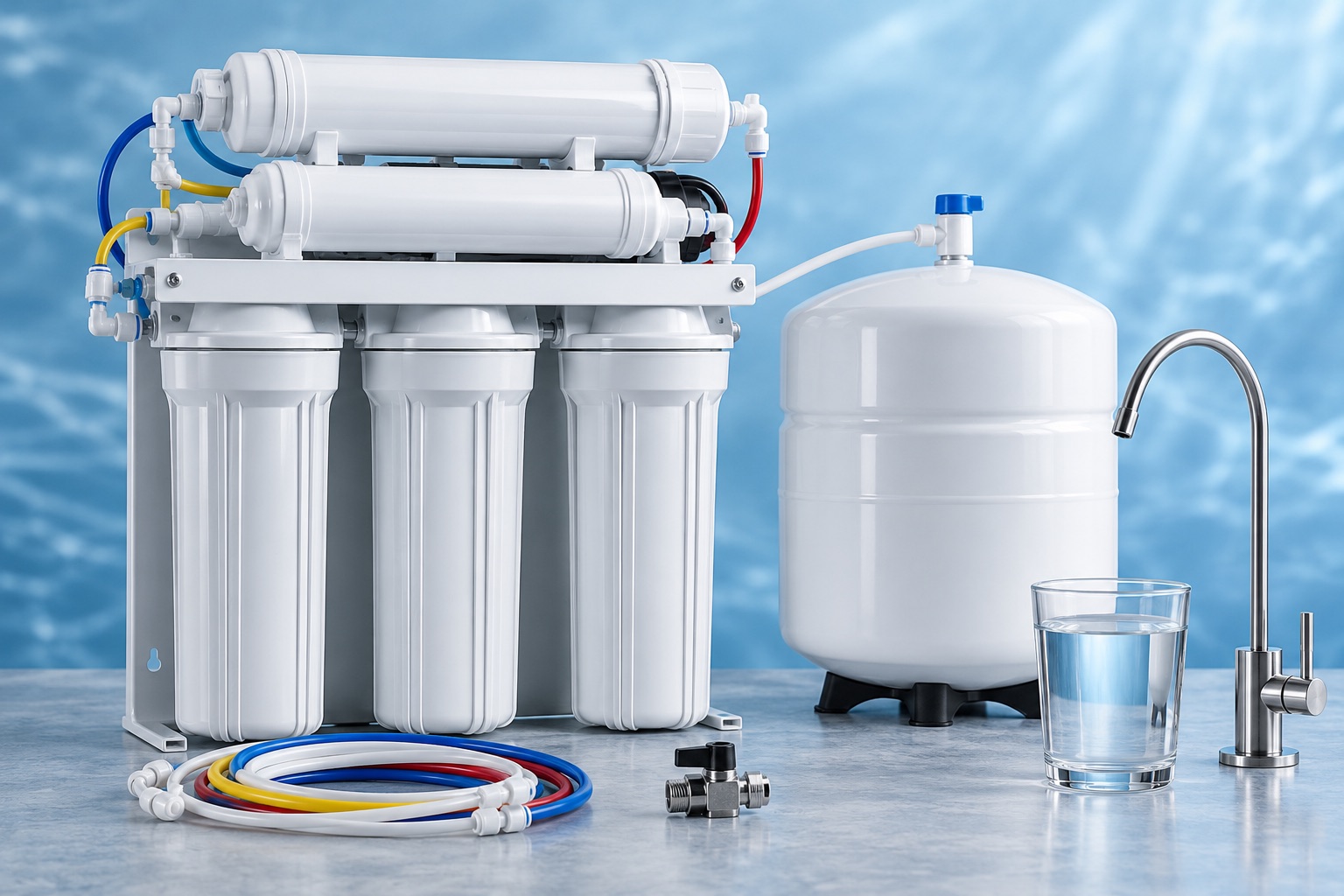
A proven five-stage design with standard-size filters and a separate pressure tank. The tradeoff is a larger cabinet footprint, slower refill, and more plumbing than a simple direct filter.
As an Amazon Associate I earn from qualifying purchases. We do not claim firsthand testing.
Original editorial image, not an exact product photograph.
The purchase decision
The ROES-50 makes sense for a household that wants reverse osmosis at a dedicated kitchen faucet, has enough cabinet room for both the filter assembly and pressure tank, and prefers a system that does not need an electrical outlet. It is especially worth considering when standardized ten-inch pre-filters and a familiar service layout matter more than a slim cabinet profile.
See the system
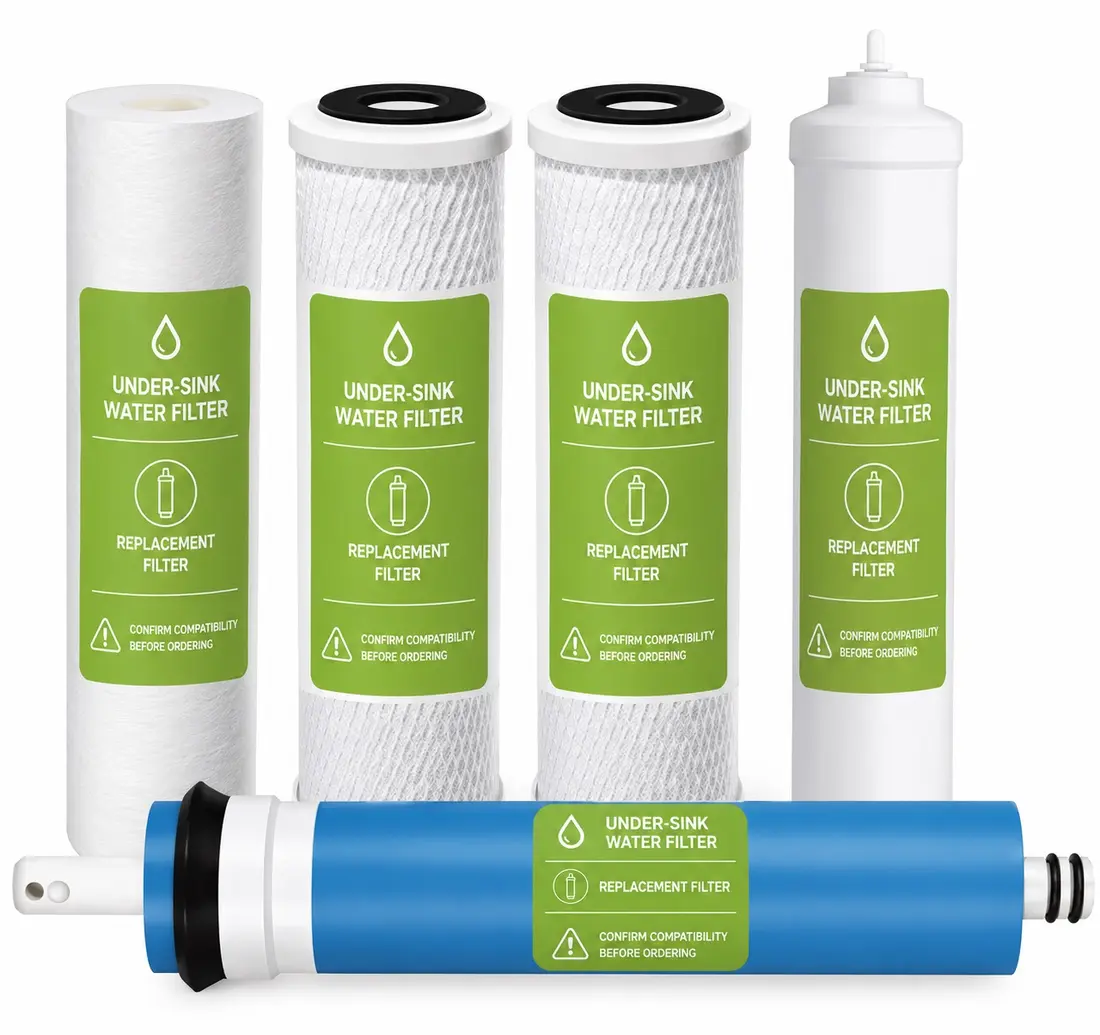
The five stages include sediment, two carbon-block pre-filters, a 50 GPD reverse-osmosis membrane, and an inline post-carbon filter. The complete FILTER-MAX-ES50 kit covers all five stages, but they do not all expire at the same time.
ROES-50 at a glance
The pressure tank stores treated water so a glass or small pot can be filled without waiting for the membrane to make water in real time. The system works without electricity, which simplifies cabinet planning, but the tank needs time to refill after heavier use.
Avoid it when cabinet space is tight, you want high sustained flow for repeated large fills, you do not want a drain connection, or you prefer a mineralization stage. It also is not the right tool for whole-house hardness, sediment, or untreated microbial risk without a broader treatment plan.
Everyday benefits
These benefits come from the published design, specifications, and maintenance requirements. They are not firsthand test results.
The ROES-50 relies on incoming water pressure rather than a powered booster pump, so installation does not depend on an electrical receptacle beneath the sink.
The pressure tank gives the faucet a ready reserve for normal drinking and cooking instead of making every glass on demand.
Its ten-inch pre-filter layout is easier to understand than many proprietary sealed cabinets, although every stage still needs the correct specification and connection.
APEC publishes separate intervals for the pre-filters, membrane, and post-carbon stage, which makes long-term planning more predictable.
Read the exact claim scope
APEC describes the ROES-50 as a WQA Gold Seal certified system, and the current exact Amazon listing names NSF/ANSI 58 and 372. Treat those references as model-specific. Review the current certificate or performance material for the exact reduction claim that matters in your home.
APEC also lists 30 GPD at 50 psi and 77°F. Actual production changes with pressure, temperature, water chemistry, and filter condition.
The tank supplies ready water at the faucet but occupies additional cabinet space and refills after use.
The current product page separately lists the tank at about 11 × 11 × 15 inches. Leave room for tubing and filter removal.
Use the current performance sheet or certification listing for the named model. Do not transfer a claim to a related model, third-party cartridge, private well, or unknown water source without supporting documentation.
Check the official documentation (opens in a new tab)Installation reality
Plan for the filter assembly, the separate tank, a cold-water feed, a drain saddle, a dedicated faucet opening, tubing bends, and enough vertical clearance to unscrew the lower housings. Incoming pressure must also stay within APEC's listed range.
Review the current manual before drilling or changing plumbing. Use a qualified plumber when the shutoff valve, drain, sink material, faucet opening, water pressure, or local code makes the installation uncertain.
Cost of ownership
Filter life depends on the manufacturer limit, water quality, and household use. Set aside maintenance money before choosing the system, and buy by exact part number.
Sediment and carbon pre-filters protect the membrane and address chlorine, taste, odor, and particles within the documented claim scope.
The 50 GPD membrane is the core dissolved-solids treatment stage. Feed water and use affect its life.
The inline carbon stage polishes water after the pressure tank before it reaches the faucet.
Check the current seller price when you are ready to buy. We do not show a fixed annual dollar total because promotions, shipping, use, and early replacement can change it.
As an Amazon Associate I earn from qualifying purchases.
Exact-model buying path
The replacement page includes current fit notes, the part number, and the Amazon buying option.
Compare before buying
These alternatives solve different household problems. The right choice depends on your water, available space, installation tolerance, and maintenance preference.
| System | Best reason to choose it |
|---|---|
| iSpring RCC7AK | Choose for a similar tanked RO layout with an added alkaline remineralization stage. |
| Aquasana AQ-5300+ | Choose for certified direct filtration with no drain, tank, or electricity when reverse osmosis is not required. |
| Waterdrop G3P600 | Choose for a slimmer powered tankless layout and higher nominal on-demand output. |
| AquaTru countertop systems | Choose when you want reverse osmosis without changing the plumbing beneath the sink. |
Decision guide
Questions before buying
No. The standard ROES-50 uses incoming water pressure and a pressure-storage tank. It still needs a cold-water connection, drain connection, and dedicated faucet.
APEC currently lists the filter assembly at about 15.5 by 5.25 by 17 inches and the tank at about 11 by 11 by 15 inches. Leave extra room for tubing, shutoff access, and removing the filter housings.
APEC recommends the sediment and carbon pre-filters about every 6 to 12 months. The membrane and post-carbon filter are generally listed for 2 to 4 years, subject to water quality and use.
No. The model names represent different capacities and treatment configurations. Confirm ROES-50 on the system and listing before buying the system or FILTER-MAX-ES50 replacement kit.
No. This guide is based on current manufacturer documents and the exact Amazon listing. It does not present firsthand or laboratory test results.
Research record
This is a research-based buying guide built from current manufacturer material and exact Amazon listings. It is not a firsthand product test. Specifications, packages, prices, certification listings, and availability can change.
Ready to compare the current offer?
Then review the current seller, return terms, warranty, availability, and checkout total.
Affiliate disclosure: As an Amazon Associate I earn from qualifying purchases at no additional cost to you.