Consider it if
- You want a small personal filter as part of a hiking or camping kit.
- You are comfortable drinking through a straw or using a compatible bottle.
- You will learn the cleaning routine and check the filter before heading out.
A small backup for the trail
If you want a filter you can tuck into a hiking bag and drink through when you need it, this is worth a look. The tradeoff is simple: a straw is convenient for a quick drink, but you still need a plan for carrying water and treating the risks it cannot handle.
Buy on Amazon (opens in a new tab)As an Amazon Associate I earn from qualifying purchases. Check the current seller, pack count, delivery and return terms on Amazon. Prices and availability can change.
The straw alone does not remove viruses, chemicals, heavy metals or salt. It is not a solution for every outdoor water source.
Research by Find My Water FilterHow we research
Sources and Amazon listing checked November 3, 2026. This is a researched buying guide; we have not field-tested this product.
Start with your routine
For a group, a squeeze or gravity setup may be easier to live with. For everyday kitchen use, start with our pitcher guides or complete system guides and match treatment to your water.
LifeStraw’s product information describes a membrane microfilter for bacteria, parasites and microplastics. Its filter-versus-purifier explanation explicitly says this type of filter does not remove viruses.
| The useful part | A personal way to filter the microorganisms and particles named in the manufacturer’s claims. |
|---|---|
| The limit | The straw alone does not treat dissolved chemicals, heavy metals or salt. Do not use it for chemically contaminated water or seawater. |
| Your decision | Choose the water source and treatment plan before you rely on the filter. Clear-looking water does not establish that the source is suitable. |
Read the manufacturer’s use and safety instructions before a trip. If local authorities advise a particular treatment or say a source is unsafe, follow that advice rather than assuming a straw makes it suitable.
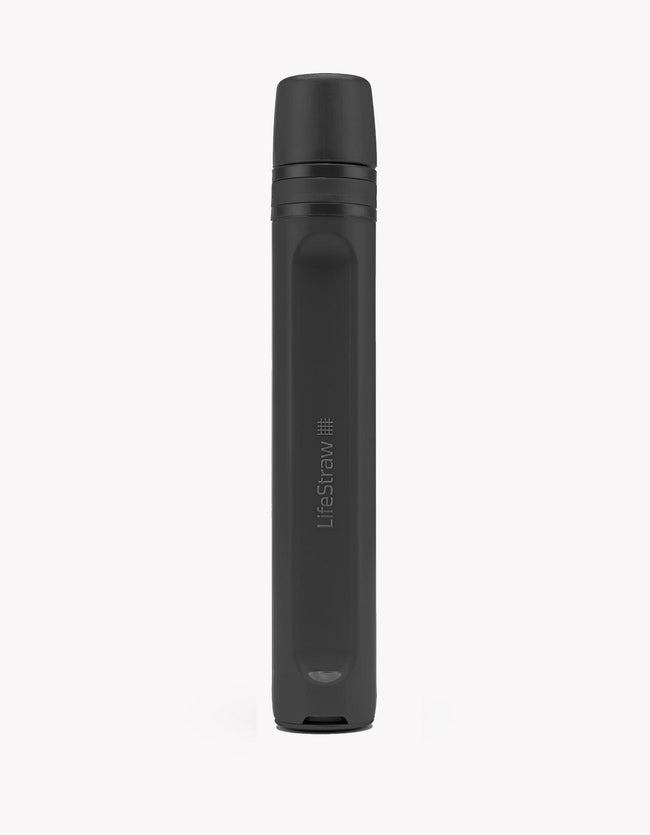
The removable bottom cap lets the Peak Series Straw connect to some standard bottles with 28 mm threads and to compatible gravity hoses. You can also collect source water in a container and drink through the straw. Check your bottle connection at home rather than discovering a mismatch on the trail.
The user manual says to open the cap and take five quick, strong sips to start flow. If first use is difficult, the current care guide suggests opening the bottom cap and soaking that end for 20 seconds to hydrate the filter.
Keep the mouthpiece and the outside of your drinking container clean. Having a filter does not help if untreated water is transferred onto the part you put in your mouth.
LifeStraw’s replacement guide lists up to 4,000 liters / 1,000 gallons for the Peak Series Straw. That is a rated maximum under suitable conditions, not a promise of a fixed number of years. This model has no replacement filter element.
After use, follow the manufacturer’s backwashing and cap-cleaning instructions. Its care guide warns against freezing temperatures, extreme heat and using a cracked filter. A glovebox or unheated vehicle may be a poor place to leave it.
Storage also changes after the first use. LifeStraw’s current storage guide says a used membrane needs proper storage when it will sit for more than three to four days and describes a saline-storage routine. Read that full procedure before putting a used straw away. The unused shelf-life claim is not a substitute for looking after a wet filter.
The buying buttons open the listing for the Peak Series Straw, Dark Mountain Gray, 1-pack. Check that Amazon still shows that selection, then compare the seller and checkout total. Do not mistake a carry case, replacement membrane for another Peak model, or two-pack for this option.
You are buying a personal straw, not a storage bottle or a complete group-water system. If you need a bottle or gravity setup, confirm what is actually included and budget for the complete setup.
Buy on Amazon (opens in a new tab)Affiliate link. Amazon may show buying options from different sellers; we do not publish a fixed offer price here.
No. LifeStraw distinguishes this membrane filter from its virus-removing purifiers. Choose treatment appropriate to the source and follow local water-safety advice.
No. LifeStraw lists the Peak Series Straw as a product without a replaceable filter element. Replace the straw at the end of its working life. A replacement membrane sold for another Peak product is not a refill for this straw.
LifeStraw says it connects to some standard single-use bottles with 28 mm threads using its removable bottom cap. Check the connection before a trip; it is not a promise that every bottle will fit.
No. They are separate products in LifeStraw’s range. Check the exact product name and pack count when comparing listings; this guide links to the Peak Series Straw in Dark Mountain Gray, one pack.
We checked the exact Peak Series Straw, rather than borrowing specifications from Peak Solo, Squeeze or Go models. Manufacturer claims remain claims for the named product; this guide adds practical buying context.
If a personal straw matches your trip and water-treatment plan, check the current Amazon options. If you need to carry more water or treat different contaminants, choose the equipment around that need first.
Buy on Amazon (opens in a new tab)As an Amazon Associate I earn from qualifying purchases.
Explore Portable & Outdoor Filters →